
This piece is a counterpoint to Madeline Armstrong’s Daily Breeze article, “Proposed warehouse near refinery sparks concern among Torrance residents,” published 10/05/2026. The concerns raised deserve answers, and the answers live in the technical record.
The Project
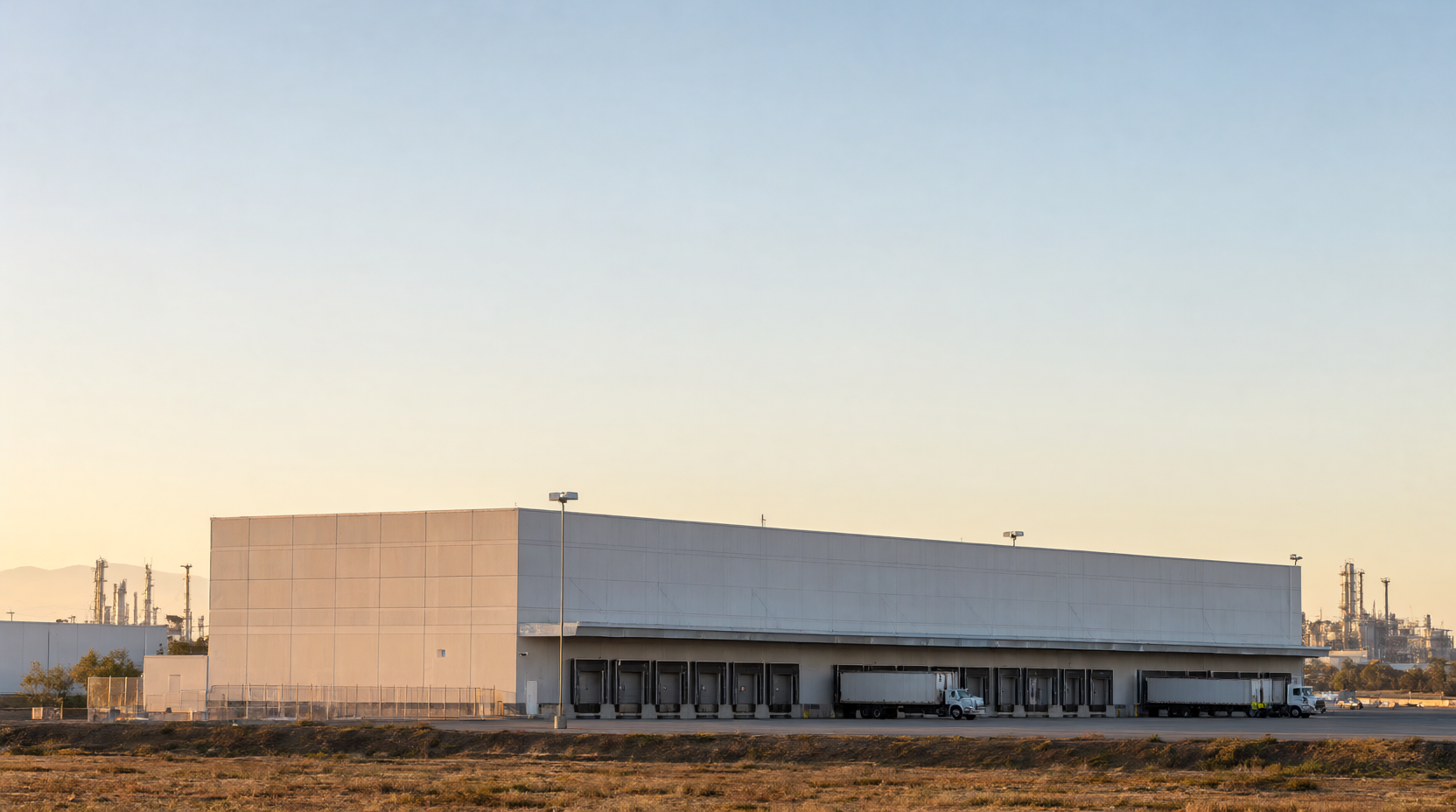
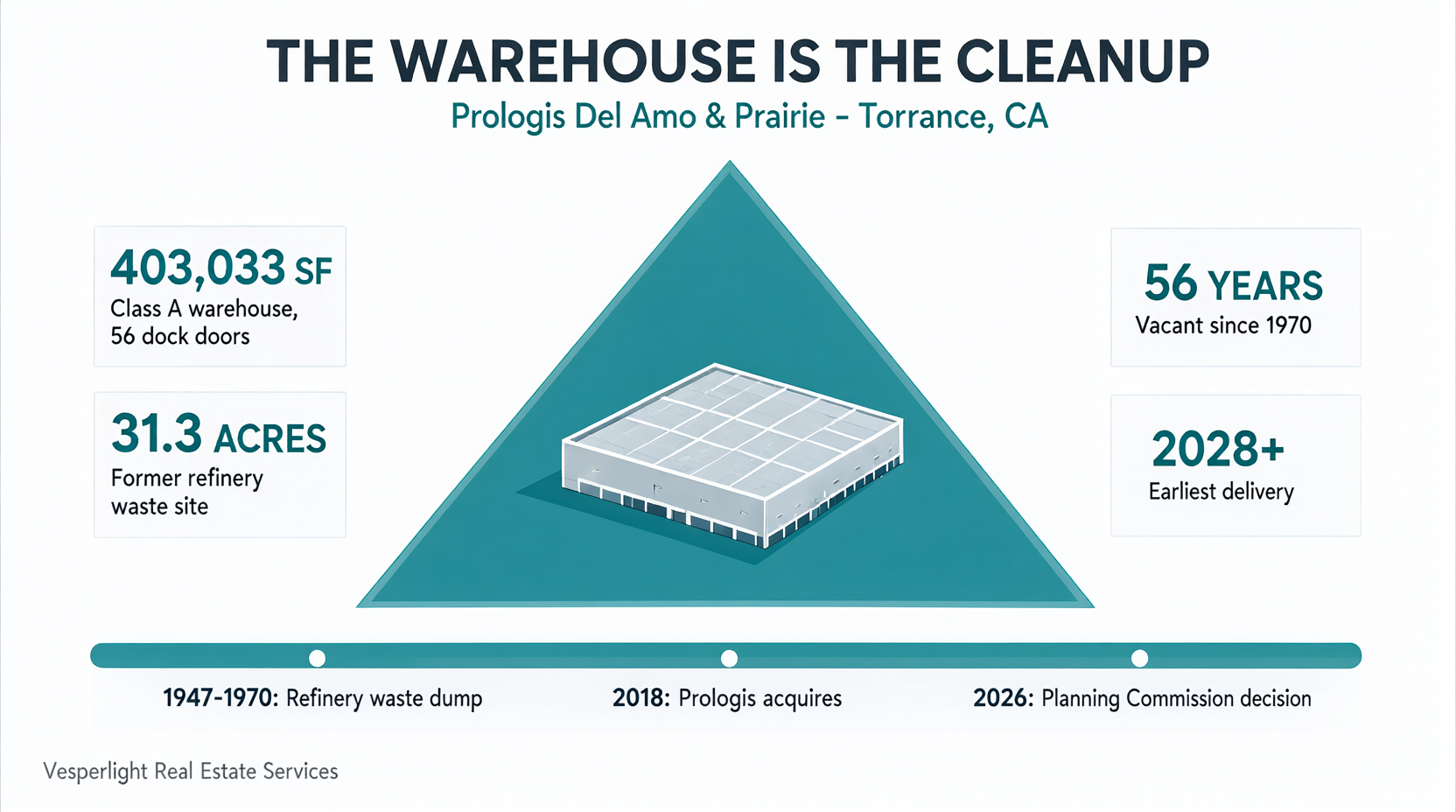
Prologis is proposing a 403,033 SF Class A warehouse with cold storage capacity on 31.3 vacant acres at Del Amo and Prairie, adjacent to the Torrance Refinery. The Planning Commission takes it up Wednesday, 10/07/2026, after two postponements.
The corner has sat empty for 56 years for a reason. From 1947 to 1970 the refinery used the land as a petroleum waste dump. Prologis bought the parcel in 2018 and has spent the eight years since working it through the state’s cleanup and permitting apparatus.
What’s in the Ground
This site carries more baggage than anything that reaches a normal hearing: petroleum waste in the soil, contamination in the soil vapor, and methane from decades of buried refinery waste. The Regional Water Quality Control Board approved the Response Plan and Soil Management Plan in August 2025 under California’s land reuse law, and the South Coast Air Quality Management District approved the site compliance plan in May 2026. Every one of those approvals is a cost someone carries before the first tenant pays a dollar of rent.
What the Public Should Know
Three concepts from the technical record explain this site better than the slogans on either side do, and they are worth understanding before Wednesday.
Methane. Decomposing petroleum waste underground generates methane gas, which migrates through soil and can collect in pockets. The science is well understood, and so is the engineering: methane barriers and sub-slab ventilation are standard practice for former refinery land, and they run permanently, not just during construction.
Undocumented fill. Nobody recorded what the refinery dumped where, so no engineer can certify what a building would sit on. The standard method is to excavate down to competent native material and replace it with engineered, tested fill. Here that means digging roughly 50 feet through the waste itself, under a Water Board-approved soil management plan. The cleanup is not a side effect of the project. The cleanup is the earthwork.
Vapor. Contamination does not stay in the dirt. Volatile compounds come off contaminated soil as gas and can migrate into enclosed spaces, which is why soil vapor is tested separately and why the plan includes vapor barriers and venting. A paved lot caps this quietly. A dig of this scale manages it actively, under approved plans, with the readings on file.
Why the Warehouse Is the Cleanup
Here is the part of the debate the opposition has not absorbed: the city’s own findings state that under the No Project alternative, remediation still occurs. The mandate to clean this land exists with or without a warehouse. What the project changes is who pays for the cleanup and what stands on the land when the digging stops.
Prologis has committed to fully fund the remediation, projected in the tens of millions of dollars. A rejected project leaves an owner holding contaminated land with no entitlement path forward, and when the owner of a contaminated site walks away, the last pocketbook standing is the taxpayer’s.
The development math explains the vacancy. A 30 percent coverage ratio, well below the 35 to 45 percent typical of Class A industrial, is what the remediation cap, the triangle geometry, and the refinery setback leave you. The buyer pays for this land twice, once to acquire it and once to make it usable. Only an owner with institutional patience and a balance sheet to match holds through eight years of entitlement on top of a cleanup of that scale.
What Remains Undecided
The merits are largely settled. The final EIR studied the alternatives and the alternatives lost: office generated more trips and more emissions, and manufacturing-only was environmentally better but commercially infeasible. The land is zoned M-2, heavy manufacturing, and has been since before most of the neighbors moved in.
What is left is a conditions fight, and two conditions matter. First, construction. The earthwork phase is where monitoring earns its keep, and the plans already call for dust and vapor protocols throughout. Publishing those readings during construction would be a low-cost way to keep the neighborhood informed while the work runs. Second, the tarplant. The site hosts one of Torrance’s three remaining southern tarplant populations, and the EIR’s mitigation for it sets no survival standard, no monitoring period, and no secured receiver site, while the dune restoration measure in the same document carries five years of quantified monitoring. A condition with no numbers in it is not a condition. It is a hope.
What This Means for the South Bay
If the project proceeds, this is a 2028-plus supply event in a corridor that almost never produces one. The South Bay does not build greenfield; a 400,000 SF delivery ripples, because every tenant this building pulls out of the surrounding market leaves a vacancy behind it. A project of this size will lease through the major industrial houses, and its absorption will show up in the submarket numbers for years after it delivers.
The truck traffic is real: 56 dock doors, 24/7 operation, more than 2,000 daily trips. The air district’s requirements are already among the strictest it imposes, with annual emissions accounting the tenants file and the public can read.
Bottom Line
The Torrance refinery site is the kind of problem that only looks like a bargain to the buyer who can afford to fix it. The land was never cheap by accident. The cleanup bill and the entitlement calendar scared off everyone who could not carry both, and the market was right about the price and wrong about nothing else. Watch Wednesday for three signals: whether the tarplant condition comes out with real numbers and dates, whether the cold storage component survives at full capacity, and whether a third postponement means real friction or just scheduling. The region needs the building. The city needs the cleanup.
Source: Madeline Armstrong, “Proposed warehouse near refinery sparks concern among Torrance residents,” Daily Breeze, 10/05/2026; City of Torrance Findings of Fact, 07/30/2026; Prologis Del Amo and Prairie Center Project Final Environmental Impact Report and appendices.
The analysis above is the author’s own read of the public documents cited. Vesperlight Real Estate Services works environmentally constrained industrial land across LA South and the MidCounties, sites where the condition is part of the price, and tracks South Bay industrial conditions daily through AIR CRE data, port statistics, and direct broker relationships.